Back to Case Studies

Case Study

Passive RF and acoustic cues for a defense prototype workflow.

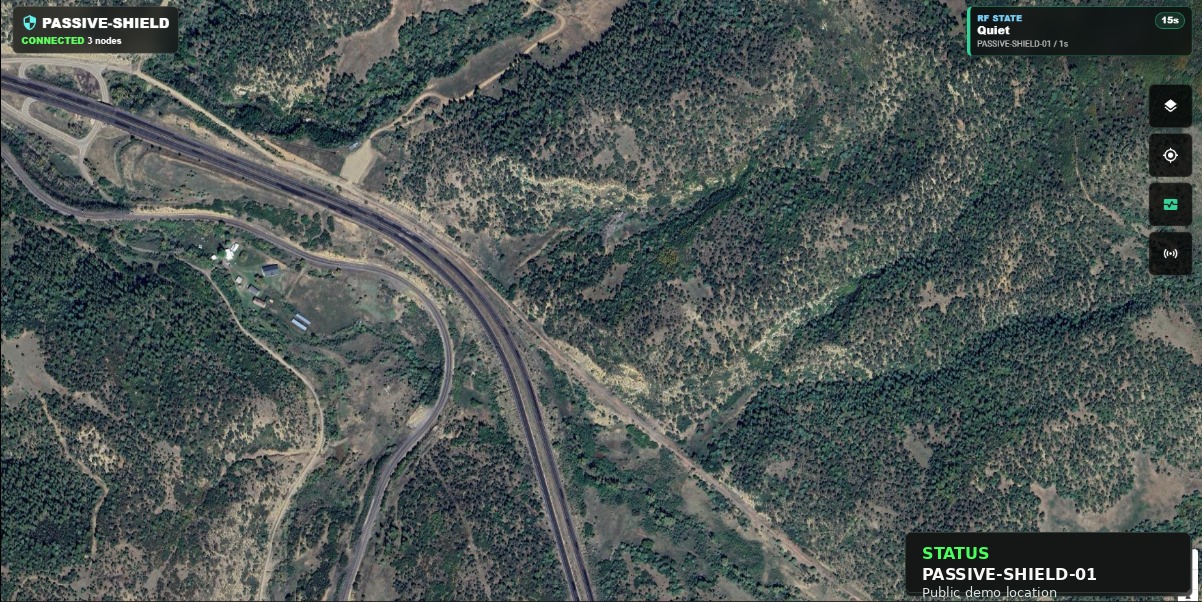
PASSIVE-SHIELD demonstrates public-safe prototype evidence for passive DJI/OcuSync-family RF cues, acoustic corroboration, edge status, event sharing, swarm replay benchmarks, and operator review.

Problem

Defense prototype cues need evidence, context, and careful boundaries.

A useful sensing prototype needs more than an alert. It needs station state, signal-family evidence, corroboration, duplicate suppression, operator context, and a public claim boundary that does not imply fielded operational C-UAS capability.

System Built

  • Passive DJI/OcuSync-family RF evidence workflow
  • Acoustic corroboration and edge-station event context
  • Deterministic multi-drone replay scenarios with ground truth
  • Measured staged-activation detection for multi-emitter evidence
  • Operator map and cue review surfaces
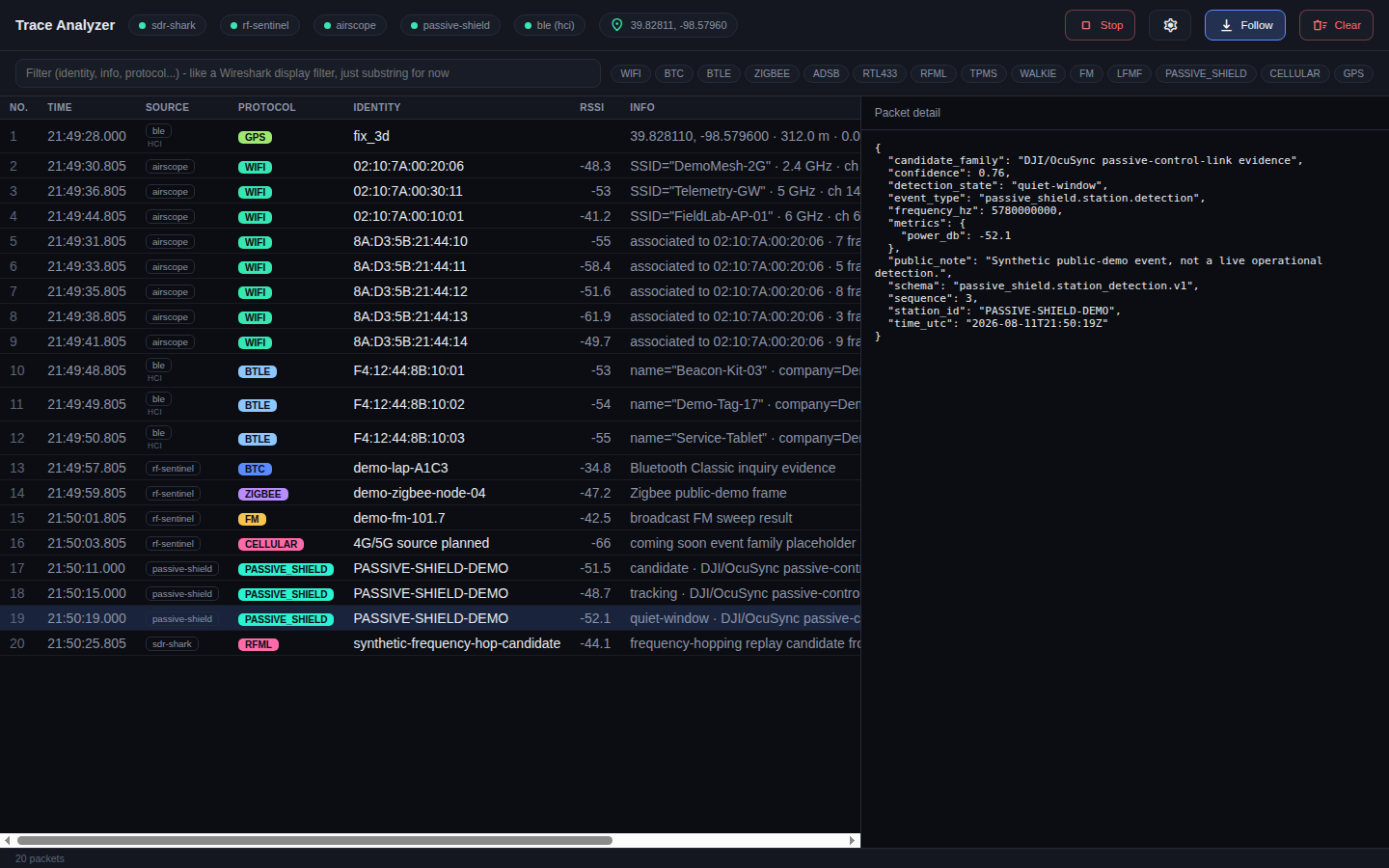
  • Trace Analyzer timeline context beside BLE, GPS, WiFi, and other RF events

Swarm Roadmap

Controlled replay is now measuring where swarm reasoning works, and where it does not.

PASSIVE-SHIELD now includes deterministic multi-drone replay scenarios that produce the same kind of event stream the prototype consumes, while keeping separate ground truth for scoring. The analysis combines two public-safe signals: level shifts that suggest staged sources joining a combined RF observation, and multi-station GeoFusion residuals that show whether observations are spatially consistent with one point source.

A conservative swarm-hypothesis layer combines those signals into bounded outputs such as sequential launch wave, staged activation detected, insufficient evidence of multiple emitters, or insufficient evidence to determine coordination. It is not presented as solved aircraft counting, internal formation resolution, simultaneous-emitter separation, or fielded operational swarm detection.
Measured Replay Result

  • Six deterministic multi-drone scenarios exercise single-drone, independent, formation, mass-arrival, sequential-wave, and mixed cases
  • Level-shift validation across twelve track-band series matched staged-source joins in nine cases
  • Multi-station GeoFusion separated the single-drone baseline from spatially spread multi-source cases in simulation
  • The hypothesis layer names sequential launch behavior but refuses to assert coordination when the evidence is ambiguous
  • False positives, false negatives, and ambiguous simultaneous groups are retained as measured limits, not tuned away
Scenario Staged activation GeoFusion residual Result
Single drone No staged join expected 53.1 m baseline Insufficient evidence of multiple emitters
Mass arrival, two axes One staged cue detected 343.3 m Staged activation detected; coordination not asserted
Sequential launch wave Multiple staged cues detected 139.4 m Sequential launch wave hypothesis
Simultaneous formation No level shift available 244.4 m Not consistent with one point source; coordination unresolved
Mixed realistic case No level shift available 302.4 m Spatial spread evident; coordination unresolved
Two independent drones No level shift available 342.1 m Ambiguous by design; avoids false coordination claim

Technical Approach

  • Represent cues as source-aware events rather than isolated alerts
  • Preserve passive RF signal-family evidence, classification context, and station state
  • Use acoustic corroboration as supporting evidence in the prototype chain
  • Use replay with ground truth to evaluate staged activation, spatial residuals, multi-emitter lower bounds, and known blind spots
  • Route public-safe event context into Trace Analyzer for timeline review

Proven and Not Claimed

  • Proven: passive RF, acoustic, station, and operator cue evidence can be connected in a prototype workflow
  • Proven: prototype cues can be reviewed in a broader source-aware timeline
  • Proven: deterministic replay can expose staged multi-emitter joins and quantify separator misses
  • Proven: multi-station GeoFusion can identify observations that are not spatially consistent with one point source in simulation
  • Not claimed: reliable drone count, internal formation resolution, or proof of coordination from RF evidence alone
  • Not claimed: fielded operational C-UAS capability, jamming, spoofing, or defeat
  • Not claimed: pilot location, home point, payload, serial, GPS decode, precision geolocation, or universal drone detection